
Land Subdivision and Plats
Dividing a tract of land is one of the few things a landowner does that is permanent. A recorded plat becomes the legal description every future deed, permit, and closing on those lots refers back to - so it has to be right the first time. Doss Land Surveying handles the whole path: resolving the parent boundary, laying out lots that satisfy the local regulations, coordinating the approvals, and setting the corners on the ground.
What This Service Covers
A subdivision divides one parcel into two or more lots, each with its own boundary, legal description, and access. That sounds simple until the requirements stack up: minimum lot size, road frontage and access, setbacks, drainage, utility easements, and - on any lot that will not be on municipal sewer - an approved area for subsurface sewage disposal. The lot lines that work are the ones drawn with all of those constraints in view at once.
The approval path depends on where the land sits. Rules and reviewing bodies differ from county to county and inside city limits, so the first real question on any division is not "where do the lines go" but "what does this jurisdiction require." We work that out before lot lines are drawn, prepare the plat in recordable form, carry it through review, and set the corner monuments so each new lot exists on the ground and not just on paper.
How the Work Runs
Resolve the parent tract.
Every division starts from a correctly resolved boundary - deeds, adjoining deeds, recorded plats, and the corner evidence in the field. You cannot divide a line you have not established.
Lay out the lots to the local requirements.
We confirm what the applicable planning office requires - lot size, frontage, access, easements - and lay out a division that satisfies it. Where lots will use septic, the soil work is coordinated so approval is in hand when the plat is reviewed.
Plat, approval, and monuments.
The plat is drafted in recordable form, signed and sealed, carried through the review and recording process, and the new lot corners are set and flagged in the field.
What You Get
- A signed, sealed subdivision plat in recordable form
- A separate legal description for each new lot
- Corner monuments set for the new lots, flagged so you can find them
- Utility and access easements shown where the division requires them
- Coordination with the reviewing office and, where lots need septic, the soil scientist
What Affects Timing
- Whether the parent tract has a current, resolved boundary or has to be surveyed from scratch
- The reviewing body's submittal and meeting calendar - approvals run on their schedule, not ours
- Soil and septic approval for lots that will not be on municipal sewer
- The number of lots and whether new road, access, or utility work is involved
- Terrain and frontage constraints that shape what layouts are actually possible
- Our current field schedule
When You Need This Survey
- Dividing family land among heirs
- Selling off part of a larger tract
- Creating one or more building lots out of acreage
- Developing a residential or commercial subdivision
- Re-dividing or adjusting the lines of existing recorded lots
Questions We Hear About Land Subdivision
Can I just split my land with a deed?
Sometimes, and sometimes not - it depends on the jurisdiction and on how the land is being divided. Where a plat is required, a division done by deed alone can leave you with a parcel that cannot be permitted, financed, or built on, and unwinding that after a sale is expensive. Tell us where the property is and what you want to do with it, and we will tell you what that county or city requires before anything is signed.
Do the new lots need septic approval before the plat is approved?
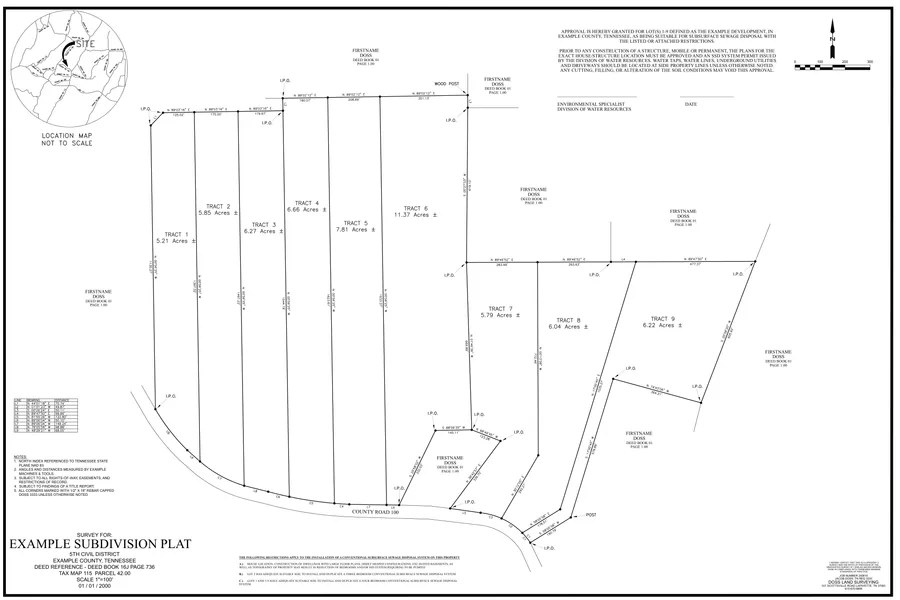
Where lots will rely on a septic system rather than municipal sewer, the disposal areas generally have to be evaluated and approved before the plat is finalized - our published nine-tract example plat carries the state subsurface sewage disposal approval block right on its face. That is why we start soil grid work early rather than treating it as a last step.
How many lots can I get out of my property?
That is set by the local regulations and by the land itself - minimum lot size, road frontage, access, terrain, and where the soils will support a septic system. It is worth answering before you commit to a plan: we can evaluate the tract and tell you what a realistic division looks like rather than drawing lines that will not survive review.
How long does a subdivision take?
The survey and plat work runs on our schedule; the approvals do not. Review bodies meet on their own calendar, and septic approval adds another party. The honest answer is that a division is a project, not an errand - start it earlier than you think you need to, and we will tell you where the real bottlenecks are for your jurisdiction.
Content reviewed by Jacob Doss, Licensed Surveyor (TN RLS 3333 | KY PLS 4612), Doss Land Surveying, LLC. Serving Macon, Smith, Sumner, Trousdale, Clay, and Jackson Counties, TN, and Allen and Monroe Counties, KY. We also take on projects throughout the rest of Tennessee and Kentucky - just ask.
Thinking about dividing a tract? Talk to us before the lot lines are drawn.
(615) 670-9856info@dosssurveying.comServing Macon, Smith, Sumner, Trousdale, Clay, and Jackson Counties, TN, and Allen and Monroe Counties, KY.
We also take on projects throughout the rest of Tennessee and Kentucky - just ask.